

Inflation has made every bill feel like a hostage situation. These five ready-to-use prompts turn ChatGPT into your personal negotiator — no awkward phone anxiety required.
Why negotiation is no longer optional
By 2026, the average American household is spending more than ever on the “boring” bills — internet, mobile, car insurance, streaming subscriptions.
What most people don’t realize is that they’re paying a loyalty tax: a silent penalty for simply not asking for a better deal. Providers quietly raise rates after promotional periods expire, knowing full well that the majority of customers will never push back.
Here’s the uncomfortable truth: the customer who calls in and threatens to leave almost always gets a better deal than the loyal customer who stays quiet for three years.
That gap — between what you pay and what a new customer pays — is money being pulled straight from your pocket every single month.
This is where ChatGPT becomes your secret weapon. Many people avoid negotiating because they feel awkward, don’t know what to say, or worry they’ll sound rude. AI removes that emotional barrier entirely.
You get a polished, confident, professionally worded script — tailored to your exact situation — in seconds. Think of it as the introvert’s superpower.
The psychology of the “big save”
Before we get into the prompts, understand one key principle: you are not begging. You are giving the company an opportunity to keep your business.
Customer retention is significantly cheaper for a company than customer acquisition — acquiring a new customer can cost five to seven times more than retaining an existing one.
The agent you speak to has real tools at their disposal: loyalty credits, promotional rates, waived fees. They use those tools for customers who ask.
When you negotiate, you’re operating in the language of market rates, competitive advantage, and customer retention. Companies understand this language deeply. Use it confidently.
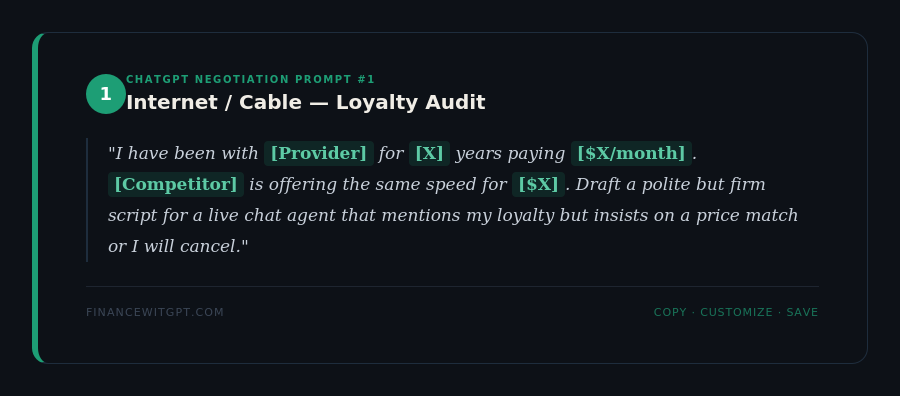
1 The internet/cable “loyalty audit”
Internet service providers are notorious for price creep. They lure you in with a $40 teaser rate, then quietly hike it to $90 after 12 months.
By year three, you’ve been paying a premium rate for a “loyal” customer who simply never complained.
This prompt works because it uses the Competitor Pivot — a tactic that forces the retention agent to pull up their internal “Save Desk” offers, which are never advertised publicly.
Writer’s tip
Before running this prompt, spend five minutes on your competitor’s website to find their current advertised rate. A real number makes the script far more persuasive — agents can see when a competing offer is live.
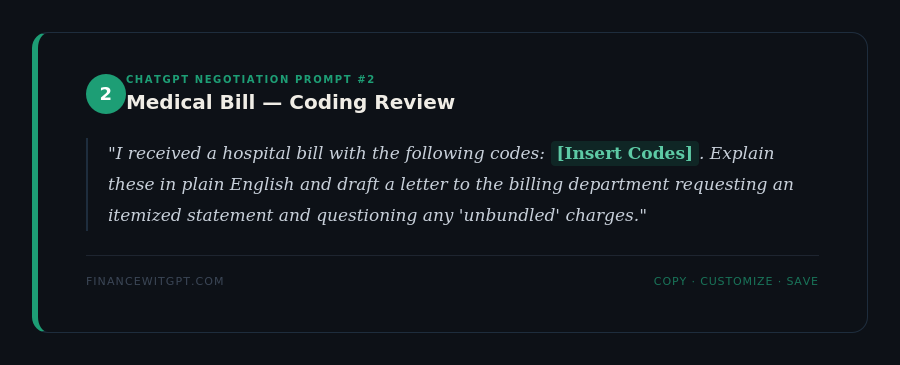
2 The medical bill “coding review”
This is the highest-value section in this entire article. Studies have found that a significant majority of hospital bills contain errors — and those errors almost always favor the hospital.
One of the most common culprits is a practice called unbundling: charging separately for a surgical kit and then also charging for each individual item inside that kit. You end up paying double for the same gauze.
Most patients receive a bill with a wall of alphanumeric codes and no explanation. ChatGPT can decode every single one of those codes into plain English — and then help you draft a professional letter that puts the billing department on notice.
Writer’s tip
When you request an itemized statement, billing departments are legally required to provide one. Many errors disappear quietly once a patient demonstrates they know what to look for.
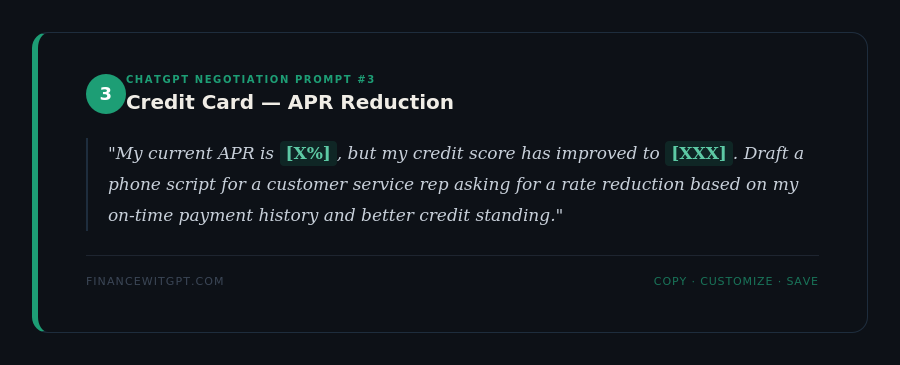
3 The credit card APR reduction
Carrying a balance at a 22% APR is essentially paying rent on your own money. What most cardholders don’t know is that a simple phone call — with the right framing — can get that rate reduced.
If your credit score has improved since you opened the card, you have leverage. Credit card issuers would far rather negotiate your rate than lose you to a balance transfer offer from a competitor.
Even a 2% reduction can save hundreds of dollars in interest over the course of a year.
4 The insurance “premium slash”
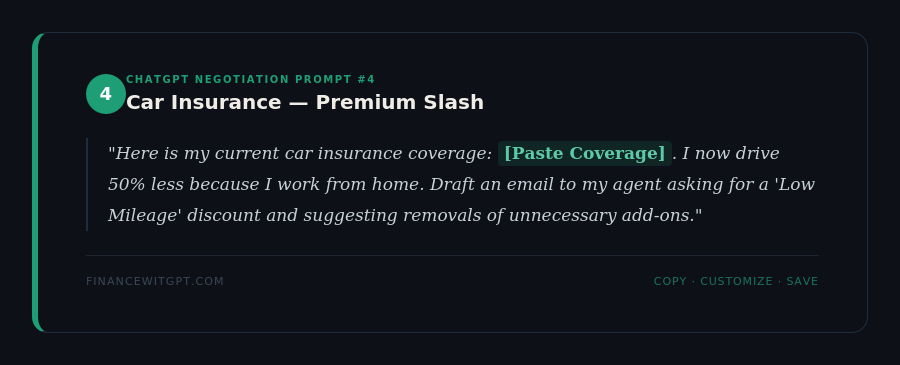
The shift to remote work has quietly created one of the most overlooked discount opportunities in personal finance. If you’re driving 50% less than you were when you signed up for your policy, your risk profile has changed significantly — but your premium probably hasn’t. Beyond mileage, most policies are bloated with add-ons that made sense at signing but no longer do. Rental car coverage, for example, is a classic case: if you have a second car sitting in your driveway, you’re paying for something you’ll never use.
Writer’s tip
Pull out your policy and look for “Rental Car Reimbursement” and “Roadside Assistance” — if you have AAA or a second vehicle, these are immediate candidates for removal
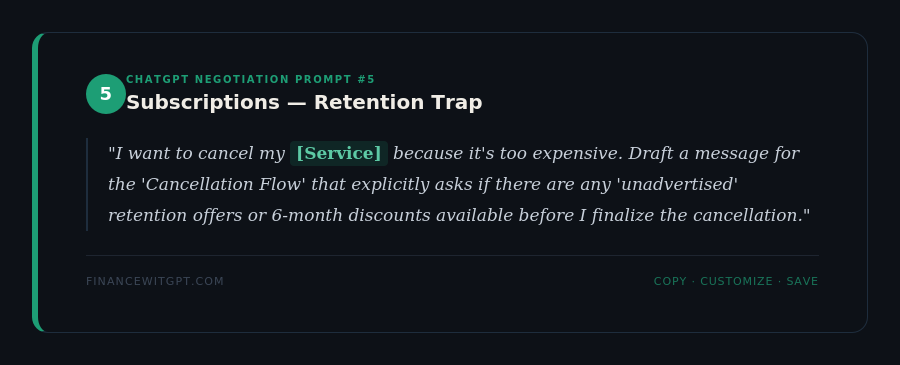
5 The subscription “retention trap”
Every subscription service — gyms, Adobe Creative Cloud, streaming platforms, software tools — has what insiders call a “cancellation flow.”
It’s the series of screens and prompts you navigate when you try to cancel. What most subscribers don’t realize is that buried at the end of that flow are unadvertised retention offers: 50% off for six months, a free pause, a downgrade to a cheaper tier.
These deals only trigger when you actually attempt to leave. This prompt puts that dynamic to work before you even pick up the phone or click the button.
The golden rules of AI negotiation
Add a human touch — AI-generated scripts can occasionally read as stiff. Read it out loud first and soften any phrases that sound robotic before you use them.
Always ask for the agent’s name and a case number at the start of any call — it signals you’re serious and creates a record.
Don’t be afraid to hang up and call back (the HUCA method). A different agent often means a different outcome entirely.
Be polite, not desperate. Confident and calm is the most effective tone — it communicates that you have options.
Time your calls strategically. Mid-week mornings often have shorter hold times and less-stressed agents.
Privacy warning — the FinanceWitGPT rule
Never paste your full name, account number, Social Security number, or date of birth into ChatGPT. Use clear placeholders in your prompts: [ACCOUNT NUMBER], [FULL NAME], [PROVIDER]. Fill in the real details only after the script is generated and you’re using it in a live conversation or letter.
Your $1,000 Saturday
Block off one Saturday morning. Make a coffee. Open ChatGPT. Work through all five prompts with your actual bills in hand. The potential savings add up faster than you’d expect:
That’s $1,200 a year — not from a side hustle, not from a budget spreadsheet, but from a few conversations where you simply asked. The companies already have the deals ready. All you have to do is use the right words.
Disclaimer: This article was generated with the assistance of AI and reviewed by our editorial team for accuracy. FinanceWitGPT provides educational insights only and is not a substitute for professional financial advice. Always verify financial data and consult with a licensed professional before making significant investment decisions.
Leave a Reply